PROTECT YOURSELF FROM SUNBURN
AFEPASA has two products in its portfolio specifically designed to protect crops from sunburn.
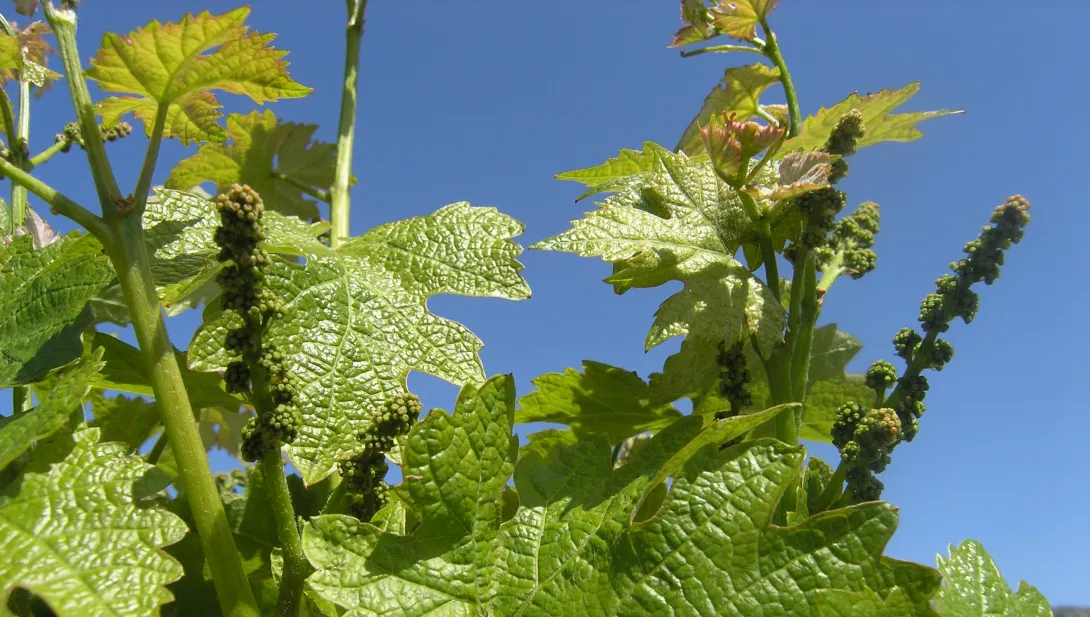
These two products from AFEPASA are designed for varieties and crops that are particularly sensitive to sunlight, although at high temperatures, all crops need this protection.
Two options:
- Solar protector with 80% sulphur in DP
- Solar protector in SC
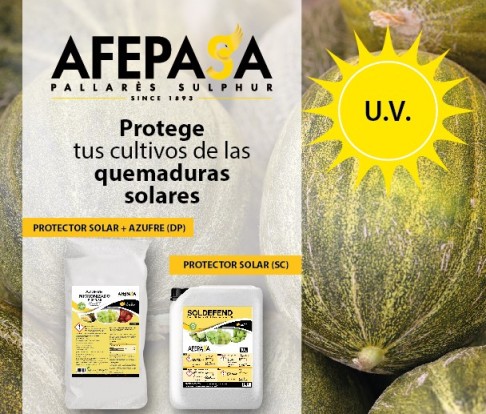
SUNSCREEN + 80% SULPHUR DP: MICRONISED SULPHUR P300/80 – Special Solar Filter (DP)
Micronised sulphur for dusting application, indicated as a fungicide and acaricide treatment, with significant solar-filtering action, formulated with an inert carrier. The incorporated mineral blend, with reduced particle sizes, effectively covers the leaf surface, providing plants and fruit with a physical barrier against solar radiation. The selected inert carrier has a suitable structure with a high refractive index.
- Reduces fruit surface temperature.
- Filters part of the ultraviolet, visible and infrared radiation, thereby reducing the risk of phytotoxicity.
- The inert carrier, with a smaller particle size, effectively absorbs radiation, providing better coverage of the leaf and fruit surfaces and thus protecting the crop.
- Prevents sunburn and, consequently, prevents fruit from darkening.
- Thanks to its application, crops do not suffer from heat stress, photosynthesis is improved, and, consequently, fruit develops a more uniform colour and size.
- Healthier, more productive crops that are more resistant to diseases and/or pests.
- Ideal for varieties with skin that is sensitive to sunlight. Examples in grapevines: Muscat, Pedro Ximénez, etc.
- Sulphur is an excellent anti-powdery mildew agent, with a suppressive effect on mites and eriophyid mites.
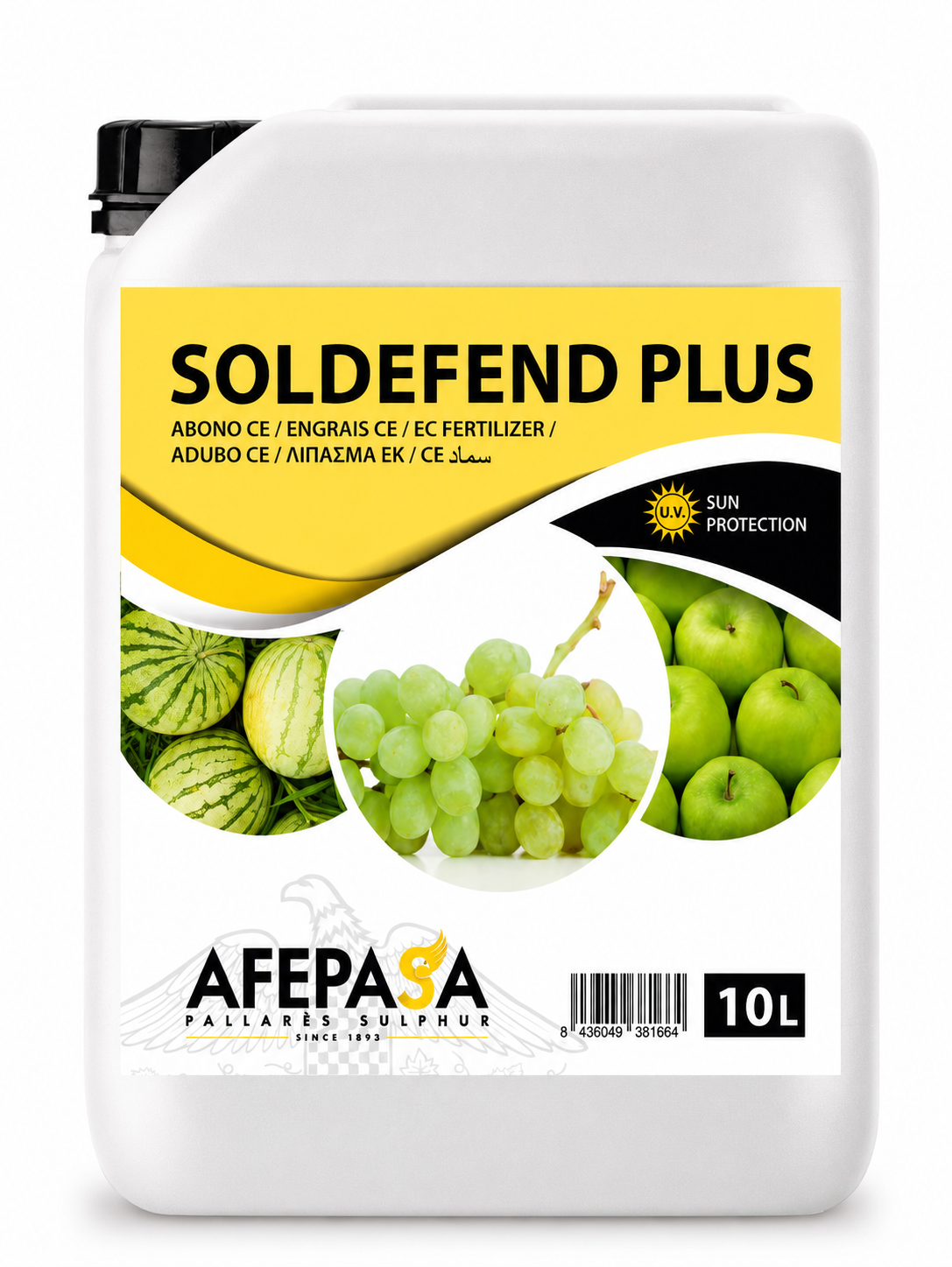
SOLAR PROTECTOR: SOLDEFEND (SC)
Effective protection against sunburn for watermelons, melons, apples, pomegranates, tomatoes, cucumbers, strawberries and grapevines. Temperatures on the surface of fruit exposed to sunlight are normally 10°C to 18°C higher than the official air temperature. As temperatures rise, the risk of damage increases: above 40°C, there is a high risk of necrotic patches; above 35°C, the risk of browning damage increases; and between 30°C and 35°C, damage varies depending on wind, sunlight intensity (cloud cover), humidity, the level of fruit acclimatisation to sunlight and other climatic factors affecting crops.
- Prevents fruit from darkening due to sunburn.
- Filters part of the ultraviolet (UV), visible and infrared (IR) radiation, reducing oxidative stress in fruit.
- Increases crop production, quality and marketable yield through its effects.
- Creates a barrier on the plant surface, preventing dehydration caused by high temperatures.
- Extends the post-harvest shelf life of fruit.
- Its particle structure facilitates surface coverage of the fruit.
Related products
Biostimulants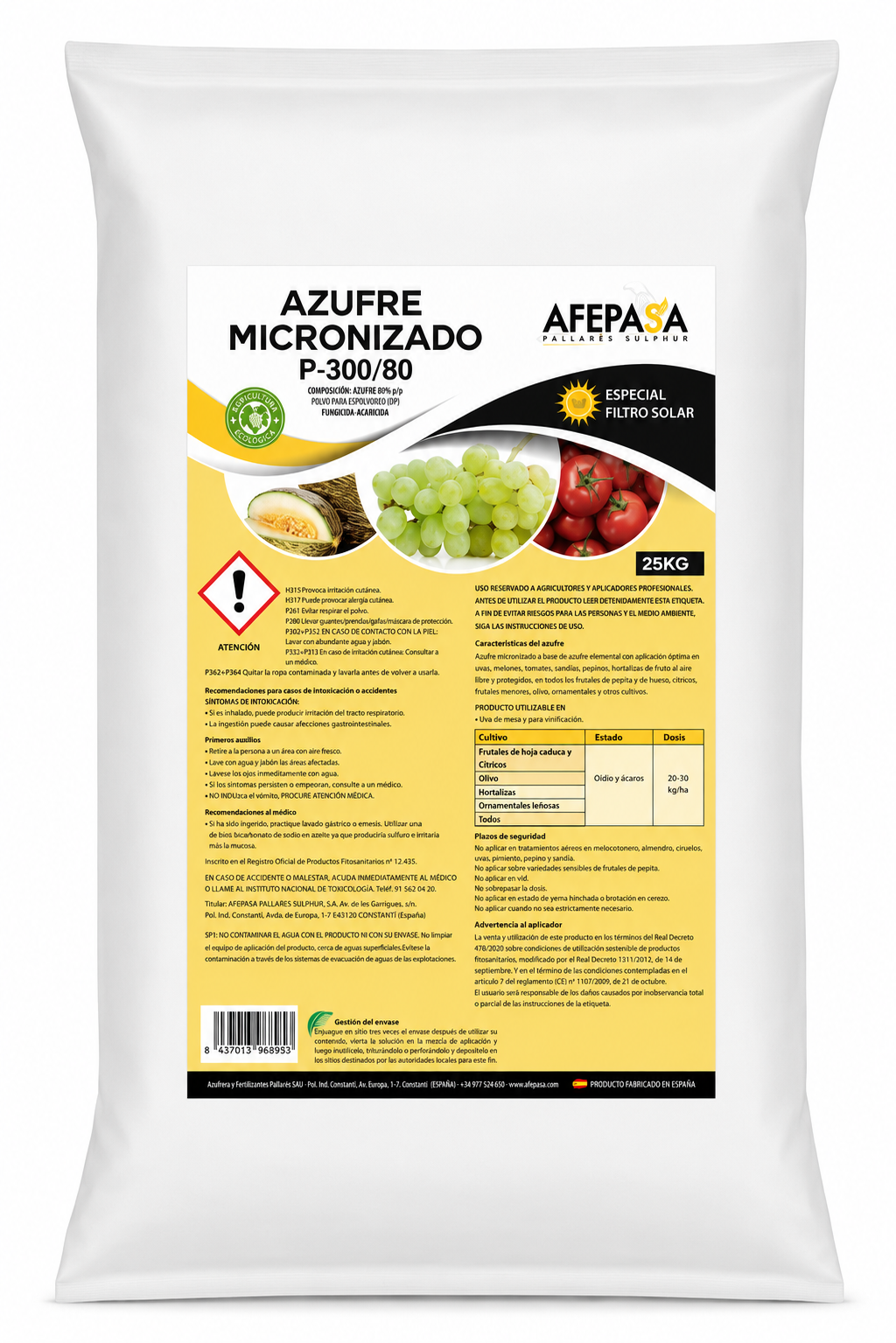 PHYTOSANITARY PRODUCTS
MICRONIZED SULPHUR 80 % - SPECIAL SUNSCREEN EFFECT
Micronized sulphur for dusting applications, designed for preventive fungicidal and…
 FERTILIZERS
SOLDEFEND PLUS
Liquid sun protectant designed to protect fruit against solar radiation and heat stress,…