Wet Milling: Particle Size Reduction and Control in Liquid Formulations
Wet Milling: Technology, Particle Size Reduction and Particle Size Distribution Control for Homogeneous Liquid Formulations, Industrial Applications and Contract Manufacturing Solutions.
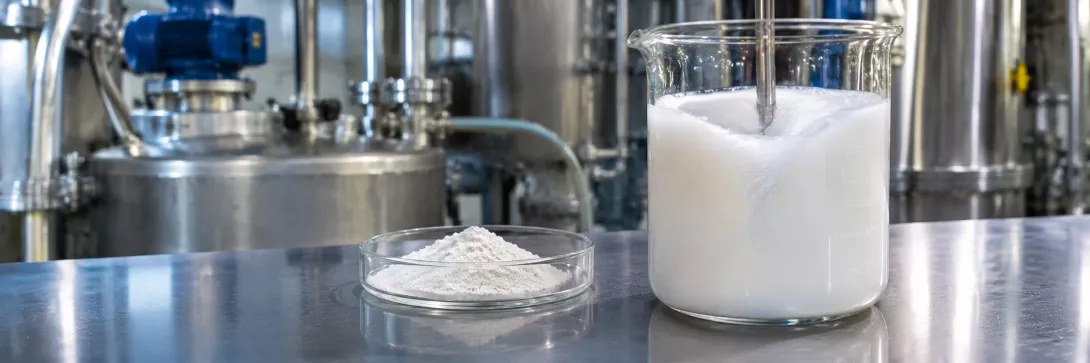
Wet milling is an industrial process used to reduce the size of solid particles dispersed in a liquid medium. This technology enables controlled particle size distributions tailored to the characteristics of each product.
It is particularly relevant in the manufacture of suspension concentrates (SC) and other liquid dispersions, where particle size influences the homogeneity and performance of the formulation.
At AFEPASA Global Solutions, we provide wet milling services for third parties, using specialised industrial equipment and adapting processing conditions to each raw material.
Wet Milling Technology and Equipment
The process combines different technologies for dispersion, agitation and particle size reduction.
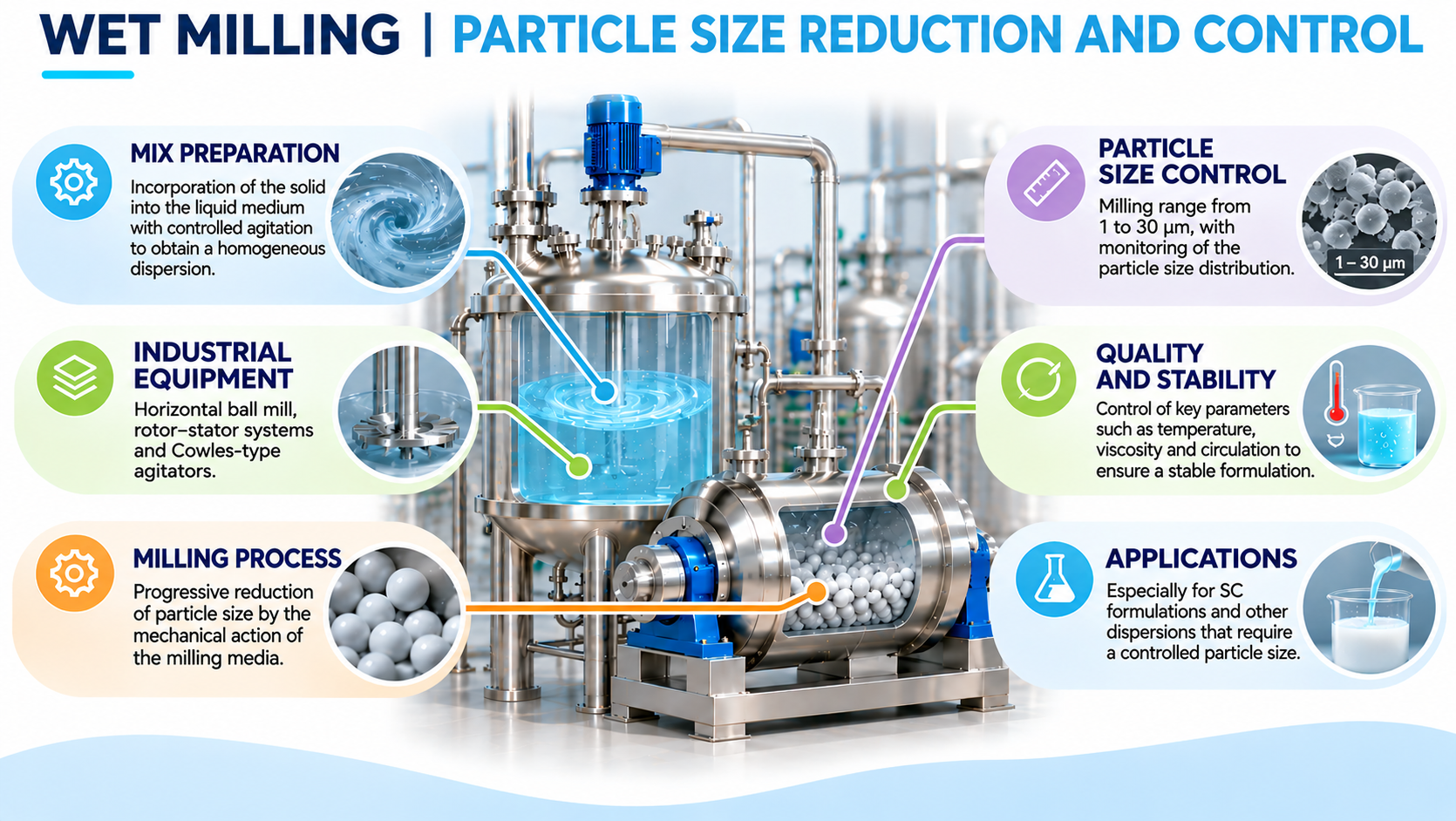
At AFEPASA, we operate horizontal ball mills, which reduce particle size through the mechanical action of the milling media.
Our facilities also include rotor-stator systems and Cowles-type agitators, used to prepare and disperse mixtures before milling.
Equipment selection depends on the properties of the material, its concentration and the established particle size requirements.
How Does the Wet Milling Process Work?
Manufacturing begins with a premixing stage, during which solid raw materials are incorporated into the liquid medium under controlled agitation.
This preparation produces an initially homogeneous dispersion and facilitates feeding into the mill.
During milling, mechanical action transfers energy to the particles, progressively reducing their size.
The process requires monitoring parameters such as temperature, viscosity and suspension circulation, which are essential for maintaining suitable operating conditions and preserving the properties of the components.
Particle Size Control: From 1 to 30 µm
One of the fundamental aspects of this technology is particle size distribution control.
At AFEPASA, we work within a milling range of 1 to 30 µm, establishing specific targets according to the characteristics of the material and the requirements of the final product.
Particle size monitoring allows us to assess process performance and determine when the required particle size has been achieved.
In addition to the average particle size, the complete distribution is evaluated, particularly the presence of coarse particles that could affect the subsequent behaviour of the formulation.
Benefits and Applications of Wet Milling
This technology enables particle size reduction directly within a liquid medium, facilitating continuity between dispersion, milling and final formulation adjustment.
Its main characteristics include:
- Controlled particle size: tailored to the product's technical specifications.
- Liquid-phase processing: integration of milling into the formulation medium.
- Homogeneity: production of dispersions with an appropriate particle size distribution.
- Flexibility: adjustment of processing conditions according to each material.
Wet milling is primarily used in SC formulations and other dispersions requiring controlled particle size reduction.
Contract Wet Milling Services at AFEPASA
At AFEPASA Global Solutions, we operate a multiproduct manufacturing facility, with validated cleaning protocols and batch-to-batch traceability.
We offer supply in bulk tankers, 1,000-litre IBCs and 20, 10, 5 and 1-litre containers, depending on project requirements.
Our contract wet milling services combine industrial technology, particle size control and manufacturing flexibility to meet each customer's technical specifications.
hu